
Artist Elias Marrow said he does not make art, but "interferes with it."
A prankster artist snuck an A.I.-generated print into a museum in Wales, where it hung on a wall for hours before staff was alerted.
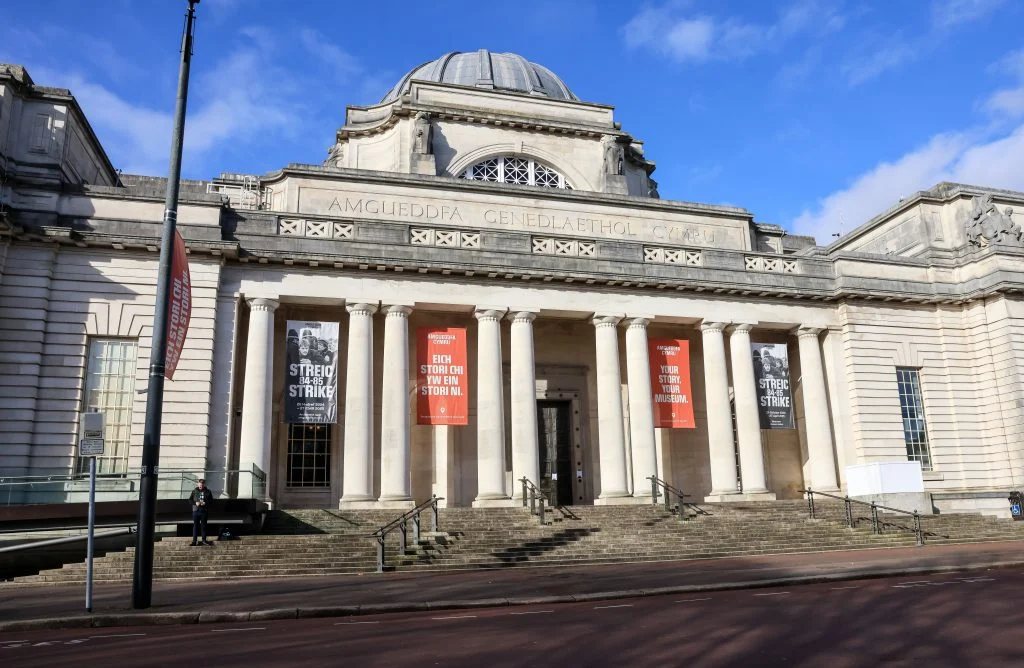
The framed image, which appeared inside the National Museum of Wales (Amgueddfa Cymru) in Cardiff last week, depicted a young boy in a school uniform, seated and holding a book under his arm and an empty plate on his lap, rendered in the style of a historical oil painting.
A piece of paper tacked on the wall next to the print identified it as Empty Plate by the artist Elias Marrow. In keeping with typical museum standards, it then listed the medium and lender: “Digital print on paper, custom made frame. Limited edition, signed. On loan from the Artist, 2025.”
The guerrilla artwork was reportedly on view for several hours in the museum’s contemporary art galleries before it was discovered. A visitor to the galleries wondered “why such a poor quality A.I. piece was hanging there without being labeled as A.I.,” according to a BBC report. They asked a member of museum staff about it, but the staffer admitted “they had no idea about the piece or when it arrived.”
“An item was placed without permission on a gallery wall in National Museum Cardiff, a spokesperson for the National Museum said in an emailed statement. “We were alerted to this and have removed the item in question.” There was no damage to the existing exhibition or to the gallery wall as a result of the artwork being displayed, they confirmed.
Marrow did not respond to a request for comment. He has posted documentation of the work on his Instagram: https://www.instagram.com/reel/DQaGTIUDejH/?utm_source=ig_embed
Further information about the work, which is meant to “represent the state of Wales in 2025,” can be found on the artist’s website. Marrow wrote of the A.I.-generated picture: “The plate is empty. The book is closed. His uniform bears the insignia of an institution long since erased. It is unclear whether he waits to be fed, punished, or simply forgotten.” A Welsh phrase follows, which translates to: “In hunger, he tries to learn; in poverty, he tries to live; in Wales, he calls it home.”
Around a quarter of Welsh children live in poverty, according to a recent report.
Marrow is a conceptual artist whose practice “interrogates permanence, authorship, and the transactional myth of meaning,” per his website. He does not make art, his statement said, but instead “interferes with it.”
It’s not the first time Marrow has “interfered” with art. In July, he placed “unsanctioned” works at two U.K. museums, including a painted brick in Tate Modern’s Turbine Hall in London and a placard on the wall at the Bristol Museum and Art Gallery, which he claims is still on view.
The Bristol Museum did not respond to a request for comment.
Whether conceptual performance or advertising ploy, Marrow’s actions are part of a long history of artists sneaking their work into museums. Last year, an aspiring artist installed one of his own paintings at the Munich museum where he worked; the institution didn’t agree with his curatorial decision and fired him.
Other artists have found success with such stunts. Danai Emmanouilidis, a sly student in the Germany city of Bonn, did secure a bit of a breakthrough when she snuck her painting into the Bundeskunsthalle in 2023, sticking it to the wall with double-sided tape. The museum found it funny and asked the mischievous maker to come forward in a post on X. Emmanouilidis later sold the work for €3,696 ($4,000) at Van Ham auction.
In 1976, conceptual artist Dove Bradshaw affixed a homemade label near a fire hose in the Metropolitan Museum of Art in New York, claiming it as her work and calling it, appropriately, Fire Extinguisher. In 2007, the Met acquired the label as an artwork for its permanent collection.
Source: https://news.artnet.com/art-world/prankster-artist-sneaks-a-i-portrait-into-uk-museum-2711267
